publications

Publications

4 papers. Entries marked abs / bib expand in place.

2026

From One-Time Choices to Future Behavior: Revising Privacy Rules for AI Assistants in Shared SpacesTo appear

Ziyuan Qu, Jiaxi Hu, Zhiqi Gao
UbiComp Companion · October 2026
pdf
abs
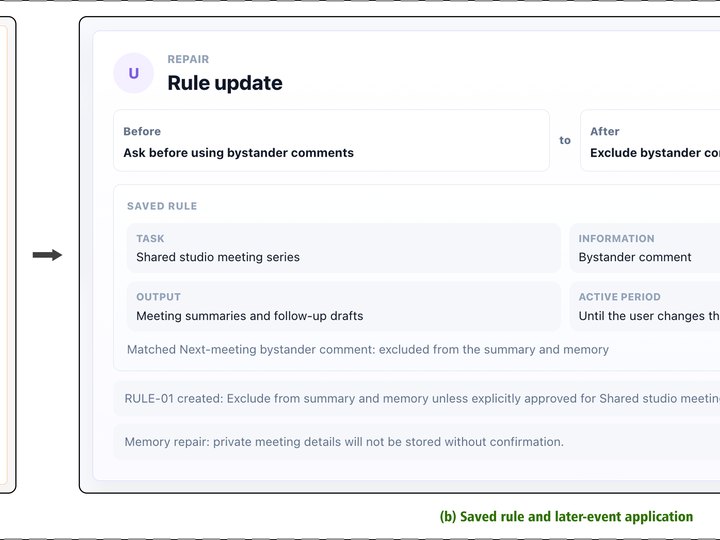
An AI assistant in a shared room hears people who never asked to be recorded. Our prototype lets the primary user set privacy rules and decide, in the moment, whether a bystander's remark may be used — then either confine that decision to the current event or save it as a rule for later ones. A five-participant formative walkthrough found everyone could complete the decision, but two could not tell which future situations their saved rule would cover. The lesson is specific: when someone saves a privacy rule, its future reach has to be visible at the moment of saving.
Mapping the Landscape of Affective Extended Reality: A Scoping Review of Biodata-Driven Systems for Understanding and Sharing EmotionsHonorable Mention

Zhidian Lin, Allison Jing, Ziyuan Qu, Fabio Zambetta, Ryan M. Kelly
CHI · April 2026
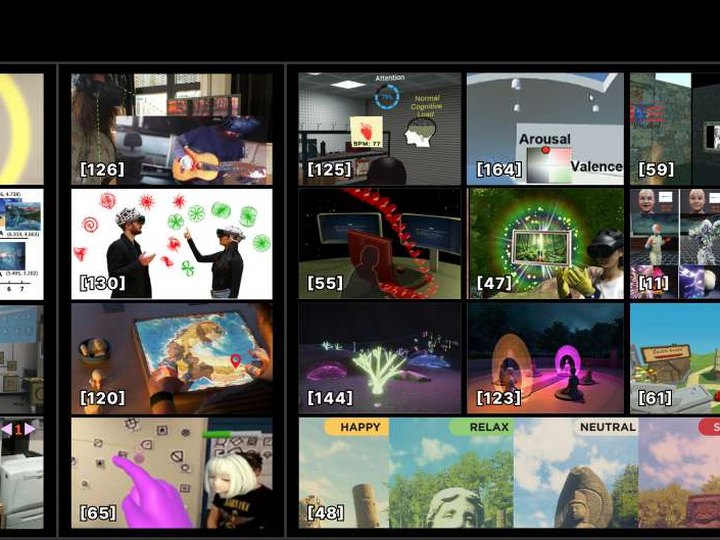
Introduces affective extended reality as a way to characterise XR systems that use biodata to make emotion understandable. HCI has produced many such systems, but they had not been mapped into a coherent whole. We reviewed 82 papers at the intersection of biodata, emotion and XR, analysing the sensing technologies they rely on, the interaction techniques they employ, and the design space they collectively describe.

Beyond the Screen: Passive Peripheral Touch for Reducing Occlusion in Mobile InteractionAccepted

Ziyuan Qu, Yibo Meng, B. Liu, Yan Guan
CHI Workshop · April 2026
abs
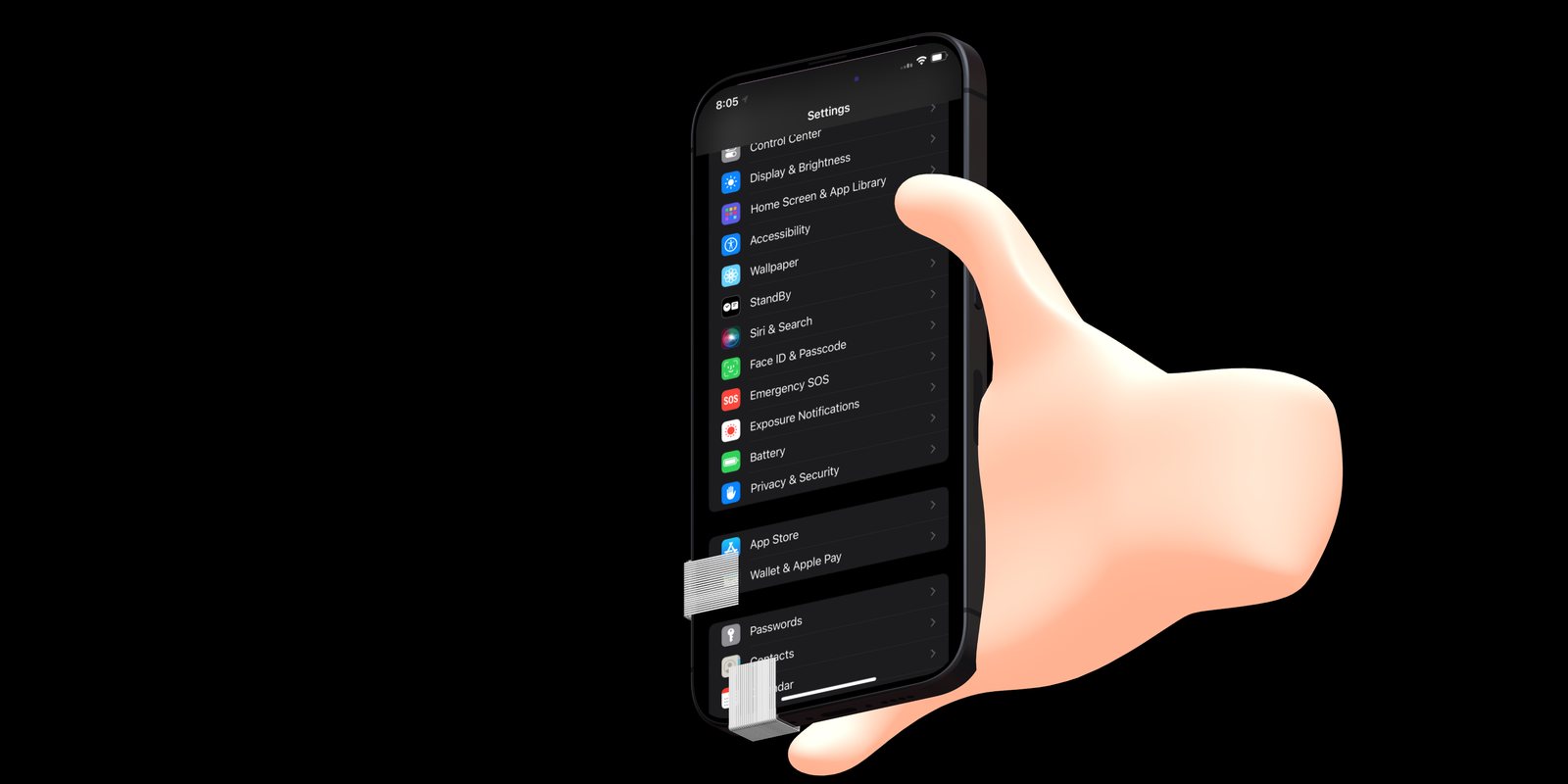
A passive, battery-free accessory that moves the finger off the screen. Metal tines act as extended electrodes so taps and swipes still register while the hand stops covering what the user is trying to read.
2025

Companion Animal Emotion and Health Status Monitoring Based on Wearable Multimodal SensingPoster · Equal contribution

Yibo Meng, Ziyuan Qu, Yan Guan
UbiComp/ISWC Companion · October 2025
pdf
abs
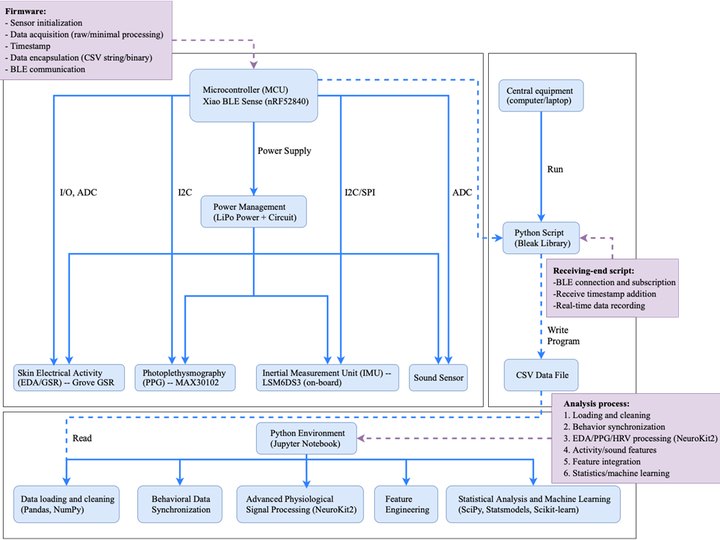
Judging how a dog feels usually depends on subjective observation. This non-invasive wearable system combines electrodermal activity, photoplethysmography, inertial sensing and audio, and applies machine learning to separate three states — excitement, anxiety and relaxation — at 78.5% accuracy. A low-cost starting point for ubiquitous animal-computer interaction.